To Feed or Not to Feed: Further Enhancing Hydrocracker Runaway Emergency Procedures
Whether to continue feed during hydrocracker emergency depressuring remains a topic of debate across the industry. Operating experience suggests that automatically stopping feed can simplify emergency response and help operators focus on higher-priority actions.
Key takeaways
- Emergency depressuring requires operators to manage multiple critical actions in a short period.
- Continuing feed during depressuring can increase operational complexity.
- Delayed feed isolation has contributed to extended outages in real hydrocracker incidents.
- Automatically stopping feed can simplify emergency response and reduce the potential for operator error.
- Emergency procedures should be practiced regularly to improve execution during high-stress events.
During a hydrocracker runaway event, operators need to make critical decisions in minutes to protect people and equipment as well as to maintain safe operation. One of the most fundamental questions discussed within the industry is whether to continue putting feed into the hydrocracker when autodepressuring or emergency depressuring has been activated.
While some hydrocracking licensors recommend maintaining feed to provide additional cooling, others advocate immediately stopping feed to reduce risk. This article provides insights into whether feed should be continued once depressuring has begun and shares lessons learned that can help facilities evaluate their emergency response strategies.
The orchestra of emergency procedures
I love listening to professional orchestras. The blending of all the instruments in harmony and rhythm creates a wonderful performance that can be both peaceful and exciting at the same time. The instruments working in synchronicity lead to a perfect result that is more effective than just one or two instruments playing by themselves.
A great emergency procedure should be just as synchronous as an orchestra, with multiple pieces working together to create an effective outcome. Although depressuring a reactor (by itself) can potentially stop a runaway, an orchestral response of many harmonious actions can be more effective and faster than just one or two actions by themselves.
To feed or not to feed?
For the purposes of this discussion, let us suppose that a hydrocracker is experiencing a temperature excursion and that our initial emergency actions failed to stop rising temperatures. Now the temperature excursion has transformed into a runaway event. At this point, it is imperative that we activate the emergency depressuring system and quickly depressure the reactor.
The big question we want to explore is: What should we do with feed once we start depressuring the reactor? Should we continue feed to the reactor, or stop it?
At least one major licensor of hydrocracking technology recommends continuing feed to the reactor to help cool it down, assuming that all cracked stocks have been removed from the feed. Nobody would want to continue feeding the reactor cracked stocks after beginning to depressure it. At least a few other licensors recommend cutting feed out of the reactor when depressuring starts.
The main advantage of continuing to feed the reactor is some additional cooling. The primary benefit of stopping feed to the reactor is that it simplifies the situation for operators and allows them to concentrate on the multitude of other critical issues that must be resolved when one stage of a hydrocracker is depressured.
Let us answer the question of “to feed or not to feed?” by considering potential problems of continuing to feed the reactor and looking at a few incidents in which this approach did not turn out well.
What if you were an operator on the hydrocracker?
On a two-stage hydrocracking unit, there are several concerns that both board and outside operators need to worry about once a reactor stage has started to depressure.
- We will assume that the reactor charge furnace is chopped, but there are at least two or more other furnaces in the unit that need to be cut back or chopped as well.
- If the runaway is in the first stage, then feed must be pulled from the second stage as the product from the first stage will be off-test and unsuitable for the second stage. Remember that the second stage recycles bottoms back to the second-stage feed, so the bottoms must be redirected away from the second-stage feed pump.
- The distillation section must be secured by pulling feed and displacing heavy stocks out of the columns to prevent equipment from waxing up.
- Some units may have the ability to circulate hot liquid in distillation columns, but this circulation must be set up by opening or closing valves and changing the routing.
- Reactor temperatures in both the first and second stages must be watched and managed.
- Unit pressure is the driving force for liquid to flow from the reactor to the separator(s) and from the separator(s) to the distillation column. As the pressure in the first stage drops, the feed will eventually need to be stopped before liquid cannot be pressured out of the unit. Stopping the feed will become a necessity within 10-15 minutes after depressuring has started.
- Hydrogen producers will need to be notified so that hydrogen can be cut back or redirected to other units.
- Coordination with tank field operators will be required to change routings and turn off pumps.
- Utilities operators must be notified that steam and fuel gas demand will decrease.
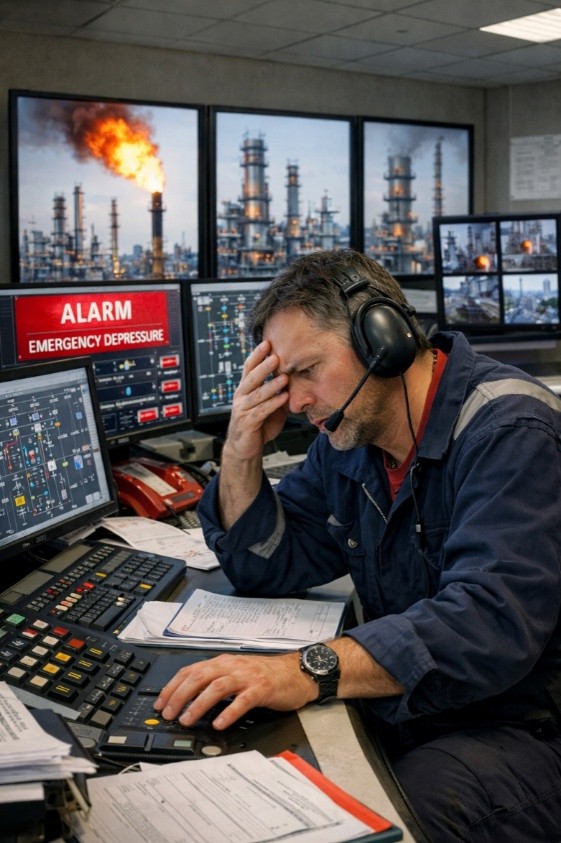
This checklist of actions is extensive but still simplified. I have observed many hydrocracking units with only one board operator for an entire two-stage unit. Taking all these actions quickly while avoiding impacts to other refinery units can be a substantial challenge even for the most experienced operators. Now imagine the potential confusion and opportunity for mistakes if the operations crew is inexperienced!
The above list probably gave you a headache as you read the required steps. Trying to actually follow them in a coordinated manner should give you a migraine! Even the best, most experienced operators are challenged by emergency shutdowns on a hydrocracker.
Two incidents where keeping the feed in the unit too long caused problems
Incident #1: Two-stage hydrocracking unit
A two-stage fuels hydrocracking unit experienced a temperature excursion and runaway event in the days before automatic depressuring was installed on the unit (early 2000s). A quench valve on the second-stage reactor was acting up, causing elevated temperatures in one bed. Operators took the usual actions to try and cool the reactor, but the temperature excursion soon spread down the reactor to other beds and temperatures began to quickly rise in the reactor.
The second-stage reactor was depressured while feed continued to enter the unit as directed by unit operating procedures. The first stage continued supplying feed downstream, but the upset caused the feed entering the second stage to be high in nitrogen. As the second stage depressured, the operators were occupied with all the other demands and forgot about taking feed out of the second stage.
Before long, the operators found themselves with a huge mess. The second-stage reactor was full of feed, and all the pressure had been taken off the unit. Fortunately, the reactor had cooled down with the depressuring, but the unit was stuck – a reactor full of feed and no way to get it out.
They debated various methods of removing liquid from the reactor, and temporary piping was eventually connected to the bottom of the reactor to slowly drain feed. There was concern that temperatures in the reactor might rise again if the unit was pressured with hydrogen, and nitrogen was not readily available. It took a few days to drain out the liquid –and several additional days to get the second stage ready for a restart.
Because the off-test second stage contaminated the reactor with organic nitrogen, the reactor was unable to reach full conversion until the excess nitrogen evolved off the catalyst, which took another week of operation. In all, keeping feed to the reactor too long caused the unit to be down for more than two weeks beyond when it should have, leading to a substantial financial penalty.
Incident #2: Mild hydrocracker
During normal operation, a mild hydrocracking unit experienced an upset with the loss of the recycle compressor. The automatic depressuring system immediately began venting the unit to flare when recycle gas flow to the reactor was lost. Per unit procedures, cracked feeds were stopped and straight-run feed continued to flow into the reactor while the unit depressured. Procedures called for stopping feed after 10 minutes, but operators were distracted and failed to do so. Feed continued to the unit for more than 45 minutes, filling up most of the high-pressure loop equipment.
The unit had a nitrogen system that allowed the reactor section to be pressured up to ~600 psig and the nitrogen pressure was used to push liquid out of the reactor/separator system. The unit was able to restart after a few days.
The incident investigation for this event caused a serious debate about adding the action of chopping feed to the depressuring system actions. Operators were adamant that there was simply too much to do during an emergency and they wanted the feed to be automatically cut out of the unit. A feed chop was added to the logic for both emergency (manual) and automatic depressuring on this unit.
Over several years, the unit was depressured a few times, with the feed chopping immediately upon activation of the depressuring system. It was proven that the cooling effect of continuing feed was minor compared to the cooling of the depressuring. The operators were incredibly happy with the addition of the feed chop to the depressuring system. The same approach has now been considered and implemented for other units in other refineries.
Conclusion: Why feed should be stopped
I was one of the primary subject matter experts involved in these two incidents, as well as other related unit upsets. As the experience level of operators has decreased, I have become a firm believer that feed should be chopped upon activation of the automatic or emergency depressuring system. In fact, I now believe that chopping feed is the correct action for all hydroprocessing units – hydrotreaters and especially hydrocrackers.
I have seen adequate evidence to believe that the small amount of cooling achieved by keeping feed in a unit is inconsequential compared to the advantages of simplifying unit operation during an emergency.
I now recommend that feed to the reactor be automatically stopped when emergency/automatic depressuring is started in all units.
I strongly encourage you consider the lessons illustrated in this article and my previous article to develop your own orchestral response to emergency events on hydroprocessing units. Well-written emergency procedures are like the music of a wonderful symphony. The operator orchestra needs to practice this “music” so it can perform flawlessly when the moment arrives. Repeated practice of emergency procedures by knowledgeable and experienced operators eliminates all sour notes during execution.

Like what you just read? Join our email list for more expert insights and industry updates.